
Commercial Health Plans: Market Landscape and Strategic Imperatives
Highlights of the report:
Download a PDF of these Highlights
Commercial health plans are operating in an environment where rising specialty spend, government pricing pressure, and employer affordability demands are all converging simultaneously. HIRC's report, Commercial Health Plans: Market Landscape and Strategic Imperatives, reviews the current market landscape and top trends for 2026, as well as commercial plans' top strategic imperatives to address over the next 12-18 months. The report addresses the following questions:
- What is the current landscape of the commercial health plan market? Which plans currently account for the majority of market share?
- What are the most notable market trends impacting commercial health plans in 2026?
- What are commercial health plans' top strategic imperatives for 2026?
- Which utilization management tactics do commercial plans apply most to manage the cost of traditional/gen med. medications?
- Which therapeutic areas are of highest priority for commercial health plans to target for additional formulary exclusions?
- Which plans are viewed as having the strongest ability to limit brand access? Which are viewed as most willing to partner with manufacturers?
Key Finding: Commercial MCOs are accelerating aggressive, financially driven formulary and contracting strategies as rising drug spend, utilization, and government pricing reforms reshape the market landscape.
Govt. Regulations/Policy Changes & Specialty/High-cost Drug Spend Among Top Trends Impacting Commercial MCOs in 2026. The top disruptive market trend identified by commercial health plan respondents in 2026 is Government Regulations and Policy Changes, followed by Specialty Drug Spend & High-cost Therapies, and GLP-1 Cost & Utilization. When it comes to the regulatory environment, the sheer speed at which the policy environment is evolving is top of mind for commercial payers, in addition to the IRA and key drug pricing reforms.
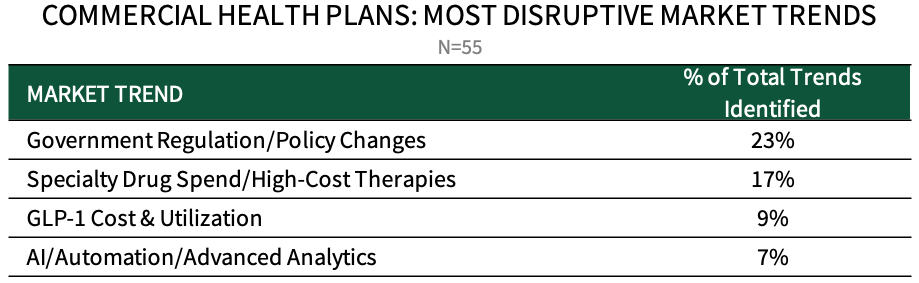
The full report examines the complete list of market trends identified by commercial plans, as well as their senior leaderships' top strategic imperatives for the next 12-18 months.
Impact of Maximum Fair Prices in Commercial Markets. Commercial plans were asked to advise on how Maximum Fair Prices (MFPs) were impacting the contracting environment for commercial lines of business. 44% of plans indicate they've used MFP as a pricing benchmark for negotiation leverage in commercial markets for diabetes medications, and 33% for heart failure medications. However, follow-up interviews reveal that while MFP reference pricing may influence negotiation framing, it has not largely and materially shifted commercial leverage dynamics.
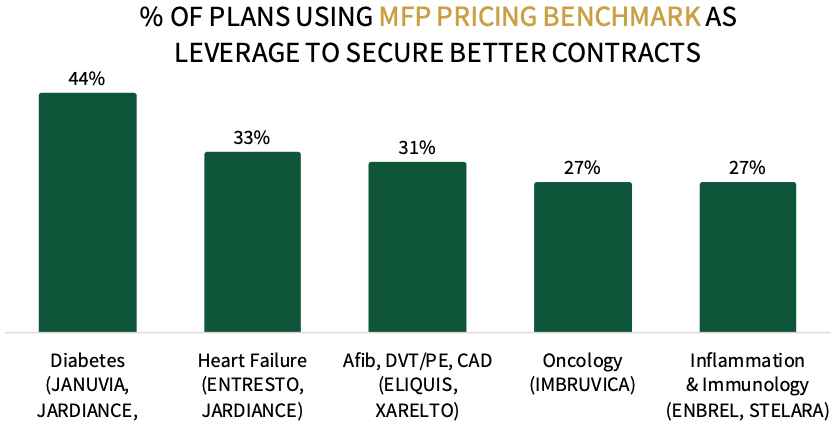
In the full report, plans comment on their contracting expectations in key therapeutic categories to avoid exclusion in future years.
Commercial MCOs Rely on Formulary & UM Tactics Most to Manage Drug Costs. Over 60% of plans’ cost and management activities for traditional medications in 2026 center around formulary and utilization management, with many seeking to prioritize generic-first strategies and expand utilization controls. Rheumatoid arthritis, GLP-1s, and airway disease medications have the highest priority for management.
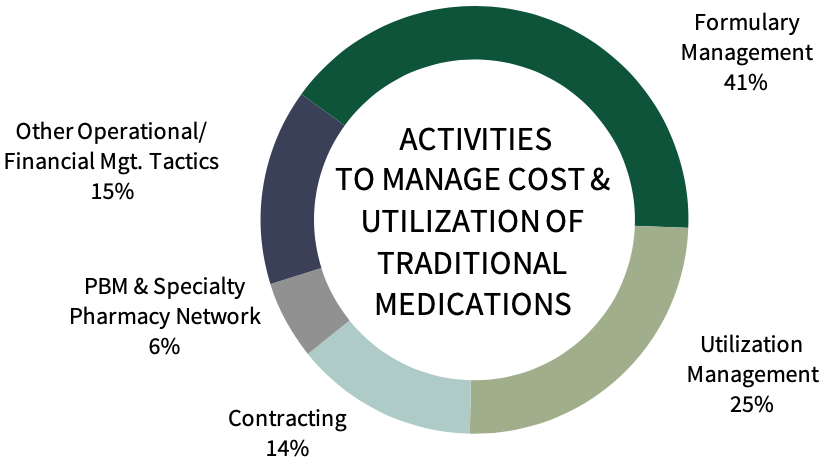
The full report examines commercial plan medication management tactics in detail across a listing of 20 broad therapeutic areas spanning traditional, specialty, and oncology.
Research Methodology and Report Availability. In December 2025 and January 2026, HIRC surveyed 55 commercial health plan pharmacy and medical directors from national, regional, and BCBS plans. Online surveys and follow-up telephone interviews were used to gather information. The complete report, Commercial Health Plans: Market Landscape and Strategic Imperatives, is available now to HIRC’s Managed Markets subscribers at www.hirc.com.
Download a PDF of these Highlights
Download Full Report (Subscribers only) >